
ESA-funded Study on Agricultural Early Warning Systems
Context
Climate variability, extreme weather and human-induced calamities increasingly threaten agricultural production worldwide. Numerous global agricultural Early Warning Systems (EWS) exist, yet strong differences in methodology, inputs, outputs, and usability remain. Countries seeking to strengthen national monitoring capacities lack clear guidance on which system best fits their agro-climatic context. At the same time, both specific user needs and Earth Observation-based monitoring capabilities are continuously evolving, calling for tight alignment between the scientific community, EWS providers and main stakeholders.
Project Scope and Objectives
The project aims to enhance transparency, comparability, and interoperability across existing agricultural EWS. Through consultation with EWS providers, users and the EO monitoring community it additionally aims to identify how recent technological and scientific advances can strengthen early warning capabilities and cater changing user needs. All of the above aspects will be bundled into a community-driven EWS roadmap, outlining current strengths, weaknesses, opportunities and threats and identifying pathways towards strengthening collaborations across the different stakeholders.
The study focuses on the major global Early Warning Systems that contribute to the GEOGLAM Crop Monitor framework, specifically:
- JRC ASAP: the Anomaly Hotspots of Agricultural Production system of the Joint Research Center of the European Commission
- FAO GIEWS: the Global Information and Early Warning System of the Food and Agriculture Organization of the United Nations
- UMD GLAM: the Global Agriculture Monitoring System of the NASA Harvest team at University of Maryland
- AIRCAS CropWatch: the CropWatch platform of the Aerospace Information Research Institute of the Chinese Academy of Sciences
- USAID FEWS NET: the Famine Early Warning Systems Network of the U.S. Agency for International Development.
These systems represent diverse methodological traditions, data inputs, and operational mandates, making them essential references for a meaningful comparative assessment.
Approach & Methodology
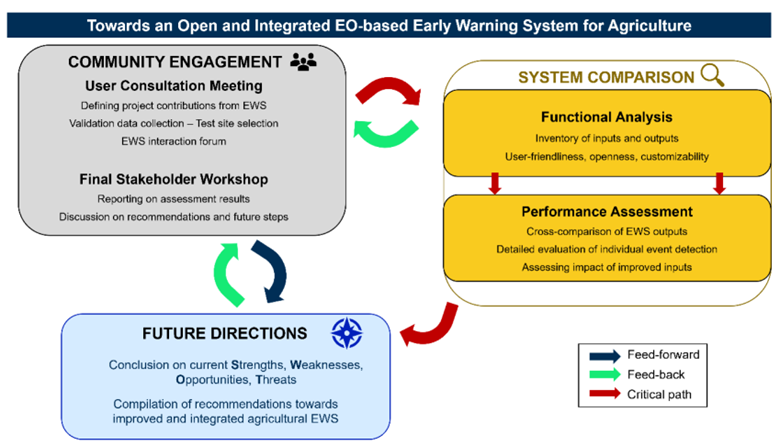
The project follows an iterative and participatory workflow, focusing on three tightly connected dimensions: understanding how systems function from data inputs to methodological design; assessing where and why their performance differs when detecting anomalies or characterizing events; and developing a strategic and technical roadmap that helps guide future improvements and collaboration efforts:
Community Engagement
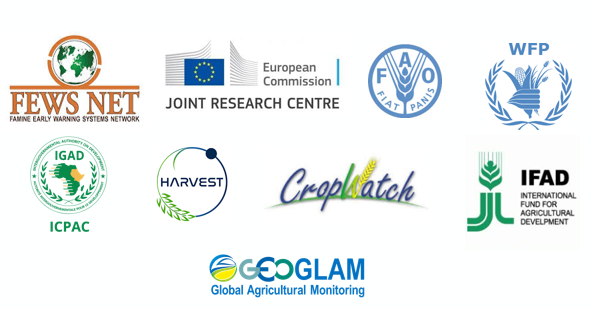
Stakeholder consultations, bilateral interviews, and two major workshops ensure shared ownership and improve access to EWS inputs and intermediate products. The first stakeholder workshop takes place in November 2025, organized with the support of FAO, and will further refine project scope and approach. The following partners are involved:
Functional Analysis
Building upon previous work from Fritz et al. (2019) and Nakalembe et al. (2021), a structured comparison for each EWS explores how data sources are prepared, how indicators are computed and translated into warnings, and how accessible, open, and adaptable each system is from a user perspective. These insights culminate in a SWOT analysis that synthesizes system‑specific strengths, weaknesses, opportunities, and threats.
Performance Assessment
The performance assessment builds on a multi‑level evaluation that compares EWS outputs across space and time, benchmarks them against independent datasets and investigates specific events in depth. The assessment will include maps and metrics that reveal where systems align or diverge. In addition, it will examine how improved inputs—such as high-resolution crop type layers—can enhance early detection and overall reliability.
Future Directions
All findings feed into a roadmap outlining integration opportunities, recommended innovations, and steps toward a more open and interoperable Early Warning monitoring ecosystem.
Outcomes and Timeline
The project started in September 2025 and will run for 1.5 years (expected end: February 2027).
Main outcomes will include reports and scientific publications covering both (1) the functional and performance assessment and (2) a strategic roadmap for agricultural Early Warning.

Consortium
- VITO – Project lead, EWS performance analysis, recommendations
- IIASA – Functional analysis, stakeholder engagement, validation
- GEOGLAM Secretariat – Community coordination


The consortium receives additional logistical support from FAO for stakeholder workshop hosting.

Activity funded by European Space Agency